Futures Hustler
Data as of 31 October 2026. Volume figures are from CME's daily bulletin for Tuesday, 27 October 2026. Fee schedules were checked on 31 October 2026.
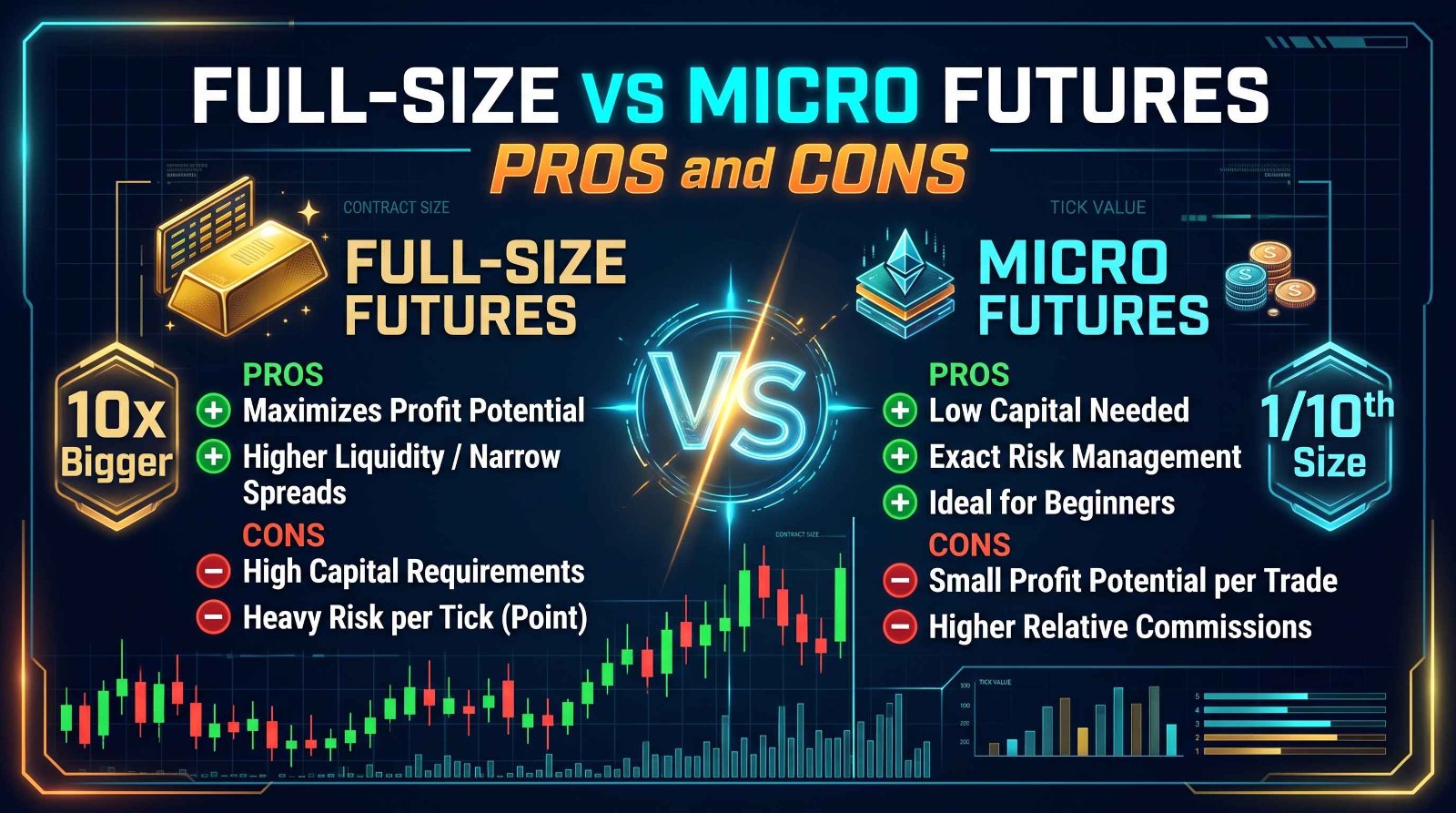
On 24 August 2026 CME Group launched a new tier of equity index futures that is smaller than the Micros: E-nano futures. They give you the same S&P 500, Nasdaq-100, Russell 2000 and Dow exposure at one-tenth of a Micro. That sounds perfect for small accounts. The catch is costs and liquidity. Here is what the numbers show.
What CME launched
There are four contracts, all cash-settled. They trade nearly 23 hours a day, Sunday to Friday, with only the next two quarterly expiries listed.
Index | E-nano (code) | Multiplier | Tick size / value | Micro tick value | E-mini tick value |
|---|---|---|---|---|---|
S&P 500 | NES | $0.50 | 0.50 pt = $0.25 | MES: $1.25 | ES: $12.50 |
Nasdaq-100 | NNQ | $0.20 | 0.50 pt = $0.10 | MNQ: $0.50 | NQ: $5.00 |
Russell 2000 | N2K | $0.50 | 0.20 pt = $0.10 | M2K: $0.50 | RTY: $5.00 |
Dow | NDOW | $0.05 | 2.00 pt = $0.10 | MYM: $0.50 | YM: $5.00 |
One detail most people miss is that the nano tick is twice as wide in index points as the Micro and E-mini tick (0.50 vs 0.25 on the S&P and Nasdaq). So one nano tick is worth one-fifth of a Micro tick, not one-tenth, and the narrowest possible spread is twice as wide in points.
The real problem: fees don't shrink
Brokers and the exchange charge E-nanos the same per-contract fees as Micros. Interactive Brokers' CME fee table lists $0.35 per side for both. NinjaTrader prices a single "Micro & e-Nano" commission tier, and Tradovate's schedule shows identical all-in rates for NES/NNQ and MES/MNQ. Topstep has said its E-nano fees match its Micro fees.
All-in round-turn cost per contract (commission + exchange + NFA/clearing) and what it costs in ticks:
Broker / plan | Round turn | NES ticks | MES ticks | NNQ ticks | MNQ ticks |
|---|---|---|---|---|---|
Tradovate / NinjaTrader Free | $1.88 | 7.5 | 1.5 | 18.8 | 3.8 |
Tradovate / NinjaTrader Monthly ($99/mo) | $1.68 | 6.7 | 1.3 | 16.8 | 3.4 |
Tradovate / NinjaTrader Lifetime ($1,499) | $1.28 | 5.1 | 1.0 | 12.8 | 2.6 |
Interactive Brokers (≤1,000 contracts/mo) | ≈$1.22 | 4.9 | 1.0 | 12.2 | 2.4 |
Topstep (TopstepX) | $1.22 | 4.9 | 1.0 | 12.2 | 2.4 |
AMP Futures | not verified* | n/a | n/a | n/a | n/a |
*AMP advertises commissions from $0.15 per side plus fees and enables E-nanos only on CQG and Teton. We couldn't find a published all-in E-nano rate, so check AMP's Exact Cost calculator.
In index points, the gap is exactly 10:1. On the Tradovate/NinjaTrader Free plan, NES has to move 3.76 S&P points just to cover fees, compared with 0.38 points for MES. NNQ needs 9.4 Nasdaq points, compared with 0.94 for MNQ. Ten NES contracts give you the same exposure as one MES but cost ten times as much in fees ($18.80 vs $1.88 round turn).
Here's a practical example. A 20-point stop on NNQ risks $4.00. A $1.88 round turn is 47% of that risk. The same stop on MNQ risks $40, and fees are under 5% of it.
Liquidity: smaller, but growing
As many traders have noticed, nano volume is far below the Micros. Here are CME's own numbers for 27 October 2026:
NNQ: 70,761 contracts traded, 16,671 open interest. MNQ: 2,536,632 traded, 131,605 OI.
NES: 10,079 traded, 6,178 OI. MES: 1,040,078 traded, 228,789 OI.
N2K: 1,288 traded, 2,730 OI. M2K: 64,977 traded.
NDOW: 2,200 traded, 1,108 OI. MYM: 137,269 traded.
Because one nano is a tenth of a Micro, NNQ's volume equals roughly 0.3% of MNQ's notional turnover, and NES is about 0.1% of MES. Growth is real, though. CME reported E-nano ADV of about 37,000 contracts in September and a single-day record above 70,000 on 28 September. Activity is heavily concentrated in NNQ.
What that means for you:
Spreads: the minimum spread is already two Micro ticks wide in points. In a thinner book, expect it to widen more often, especially overnight and around news.
Slippage: market and stop orders can fill several ticks away when there are only a few orders resting at each price.
Fills: limit orders at the touch may sit unfilled. Check live depth before you trade. Neither CME nor any broker we found publishes average nano spreads, so we can't quote a verified figure.
Verdict: active trading or swing trading?
Scalping and active day trading: generally not worth it. If you need 5 to 19 ticks just to break even, plus a wider, thinner spread, small targets don't add up. Once your account can handle the stop on one MES or MNQ, the Micro is cheaper per point and far more liquid.
Where nanos make sense:
Swing and position trades with wide stops and targets. If you're aiming for 50+ S&P points, a $1.88 round turn hardly matters. A 50-point NES move is $25, so fees are about 7.5% of it, and the cost shrinks as targets grow.
Very small accounts that can't keep a Micro stop within a 1% risk rule.
Learning with real money, where the emotional stakes are real but the dollar risk is tiny.
Fine-tuned sizing and scaling. For example, hold one MES plus a few NES to size exactly, or scale out of a swing position in small steps.
Bottom line: E-nanos are a sizing tool, not a scalping tool. Use them to fit risk to a small account or to adjust position size. For frequent intraday trading, the Micros still win on cost and liquidity.
Want a plan that tells you exactly which contract, size and stop to use for your account? Get a trading plan at futureshustler.com.
Disclaimer: This article is for education only and is not financial advice. Futures trading involves substantial risk of loss, including losses larger than your deposit. Fees, margins and liquidity change, so verify current figures with CME Group and your broker before trading.
Sources: CME Group E-nano press release (3 Aug 2026), E-nano FAQ and rule filing 26-297; CME daily bulletin Section 01C (27 Oct 2026); CME Equity Insights (Oct 2026); Tradovate commission schedule (as of 14 Aug 2026); NinjaTrader pricing page; Interactive Brokers futures commissions and CME fee tables; Topstep fee schedule; AMP Futures commission and contract-spec pages.