Futures Hustler
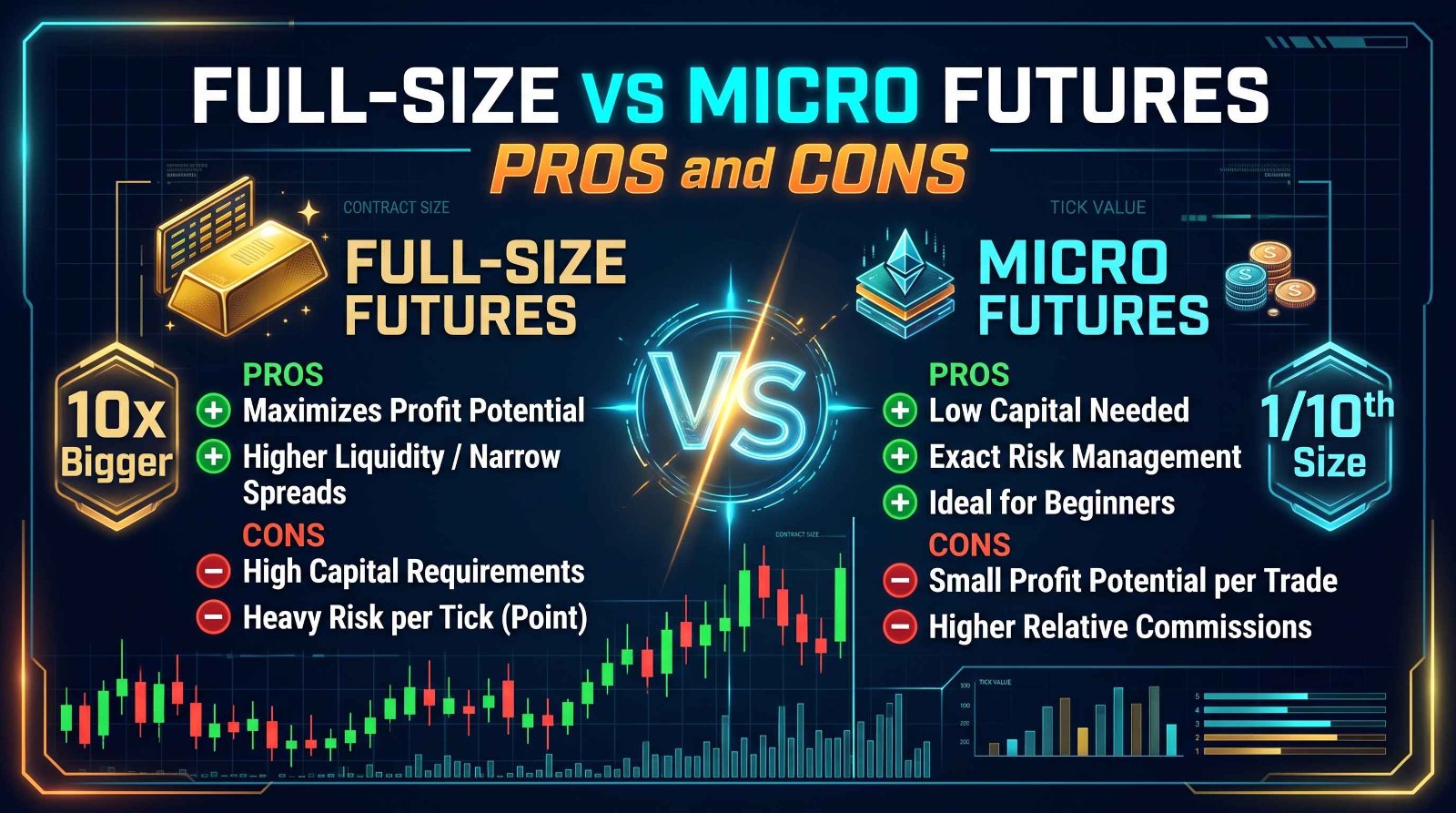
Micro futures are the better choice for most traders with accounts under about $60,000, because they let you split every trade into three contracts and scale out without risking too much. Full-size contracts win once your account is large enough to scale with them, because they cost less per dollar of exposure and offer deeper liquidity. This article compares the two side by side so you can decide which fits your account today.
Same market, one tenth the size
A micro contract tracks exactly the same index or commodity as its full-size version, on the same chart, with the same zones and setups. The only difference is size: every micro is one tenth of the full contract, so every tick is worth one tenth of the money.
Market | Full contract | Point value | Tick value | Micro contract | Point value | Tick value |
|---|---|---|---|---|---|---|
S&P 500 | ES | $50 | $12.50 | MES | $5 | $1.25 |
Nasdaq 100 | NQ | $20 | $5.00 | MNQ | $2 | $0.50 |
Crude oil | CL | $1,000 per $1 | $10.00 | MCL | $100 per $1 | $1.00 |
Gold | GC | $100 per $1 | $10.00 | MGC | $10 per $1 | $1.00 |
Euro FX | 6E | $125,000 notional | $6.25 | M6E | $12,500 notional | $1.25 |
So 10 MES move exactly like 1 ES. A 4-point move on the S&P is worth $200 on one ES and $20 on one MES.
Micro contracts: pros and cons
Pros
Small accounts can trade properly. A typical 3-contract MES trade with a 4-point stop risks $60, which fits 1% risk on a $6,000 account. The same trade on ES risks $600.
You can scale. Splitting a position into three exits (T1, T2 and a runner) needs at least three contracts. Micros make that possible on almost any account size.
Precise sizing. You can size in steps of one tenth of a full contract, so your risk matches your plan instead of being rounded up to the next full contract.
Cheap mistakes while learning. A bad trade costs one tenth of the money, so a learning curve does not empty the account.
Lower margin. Brokers ask for roughly one tenth of the full-contract margin, so less of your cash is tied up per position.
Easier on the nerves. Smaller swings in dollars make it easier to follow the rules instead of reacting to the P&L.
Cons
Higher costs per dollar of exposure. Commissions and exchange fees on 10 micros are about two to three times what you pay on 1 full contract for the same exposure.
Fees take a bigger share of each trade. A 3-micro round trip costs about $3–$4, around 5% of a $60 trade risk. Very tight stops become hard to trade profitably.
Thinner order book. Micros have less size resting at each price than the full contracts. For 3 to 30 contracts this rarely matters, but large orders can move the price a tick.
Small wins can feel pointless. A good day of +$150 may not feel worth the effort, which tempts some traders to oversize too early.
Full contracts: pros and cons
Pros
Lowest cost per dollar of exposure. One ES round trip costs roughly $4–$5, against $12 or more for the 10 MES that match it.
Deepest liquidity. ES, NQ, CL and GC are among the most traded contracts in the world. Large orders fill at the price you see.
Fewer orders to manage. Three full contracts do the work of thirty micros, so platform limits and order handling are simpler.
Wins that matter. A 4-point move is $200 per contract. On a large account, each good trade moves the balance in a meaningful way.
Cons
Big accounts only, if you want to scale. A 3-contract ES trade with a 4-point stop risks $600, which needs about $60,000 to stay at 1% risk.
Coarse sizing. Your size jumps in steps of a full contract. On a $25,000 account, one ES contract may already be more risk than your plan allows, and three is out of reach.
No room to scale on smaller accounts. With only one contract you can't take one off at T1, one at T2 and let one run; you are all in or all out.
Expensive mistakes. One unmanaged loss or a missed stop can cost hundreds or thousands of dollars in minutes.
Higher margin. About ten times the micro margin per position, which ties up more of the account.
More emotional pressure. Watching $50 per point swing back and forth makes it harder to hold a runner or take a planned loss calmly.
The real cost of the same trade
Micros cost about 2.5 times more in commissions for the same dollar risk, while slippage costs the same share of risk on both. The table compares one S&P trade with a 4-point stop, using approximate all-in round-trip costs of $4.50 per ES and $1.20 per MES (your broker's rates will differ) and 1 tick of slippage on the stop entry.
3 ES | 3 MES | 30 MES (same exposure as 3 ES) | |
|---|---|---|---|
Trade risk (4-point stop) | $600 | $60 | $600 |
Commissions, round trip | $13.50 | $3.60 | $36.00 |
Commissions as % of risk | 2.3% | 6.0% | 6.0% |
1 tick slippage on entry | $37.50 | $3.75 | $37.50 |
Slippage as % of risk | 6.3% | 6.3% | 6.3% |
Commissions over 100 trades | $1,350 | $360 | $3,600 |
Two things follow. On a small account, micros are still the right choice: $3.60 a trade is the price of being able to trade at all with proper risk and scaling. On a large account, trading 30 MES instead of 3 ES throws away about $2,250 per 100 trades in extra commissions, so that is the point to switch.
What your account size lets you trade
To scale out with three exits on ES at 1% risk, you need about $60,000. With micros, the same structure starts at about $6,000. The table assumes a 4-point S&P stop: $20 of risk per MES contract and $200 per ES contract.
Account | 1% risk per trade | MES contracts that fit | ES contracts that fit | Can you scale with 3 exits? |
|---|---|---|---|---|
$6,000 | $60 | 3 | 0 | Yes, with 3 MES |
$12,000 | $120 | 6 | 0 | Yes, with 6 MES (2 per exit) |
$30,000 | $300 | 15 | 1 | Only with MES; 1 ES cannot be split |
$60,000 | $600 | 30 | 3 | Yes, with either; 3 ES is cheaper |
$120,000 | $1,200 | 60 | 6 | Yes; full contracts are the better fit |
The middle rows are the trap. With $30,000, one ES fits the risk budget, so many traders take it. But a single contract can't be scaled: there is no T1 to pay for the trade and no runner to catch a trend day. Fifteen MES give the same risk with three exits of five contracts each.
When to move up to full contracts
Switch when all three of these are true:
The account can carry it. A 3-contract full-size trade (about $600 on ES with a 4-point stop) is 1% of the account or less.
You are already trading the same exposure in micros. You have been trading about 30 MES (10 per exit) comfortably, so 3 ES changes the cost, not the risk.
Your results are consistent. At least three months of following the rules, with a record of trades that shows a positive average after costs.
Don't switch because of a few good days, and step back to micros after any month that breaks your daily loss rules.
The hybrid option
You don't have to choose one or the other. Use full contracts for the core of the position and micros to fine-tune size. For example, 3 ES plus 3 MES gives you the low costs of full contracts with exits of one ES and one MES each. It is also a smooth way to step up: 3 ES and 6 MES is the same exposure as 36 MES, at a fraction of the commissions.
The bottom line
Choose | When |
|---|---|
Micros | Your account is under about $60,000, you are learning or rebuilding, or you want three exits on every trade |
Full contracts | Your account is $60,000 or more, you already trade about 30 micros consistently, and commissions have become a real cost |
Both | You trade full contracts and want finer control over size |
For most traders starting out, micros are not a compromise: they are what makes proper risk control and scaling possible. Full contracts become the better tool once the account has grown into them.
Risk note. Futures are leveraged and losses can exceed the money in your account. The dollar figures and costs in this article are illustrative and approximate; check your broker's actual commissions and margins. This is educational content, not advice to trade.